

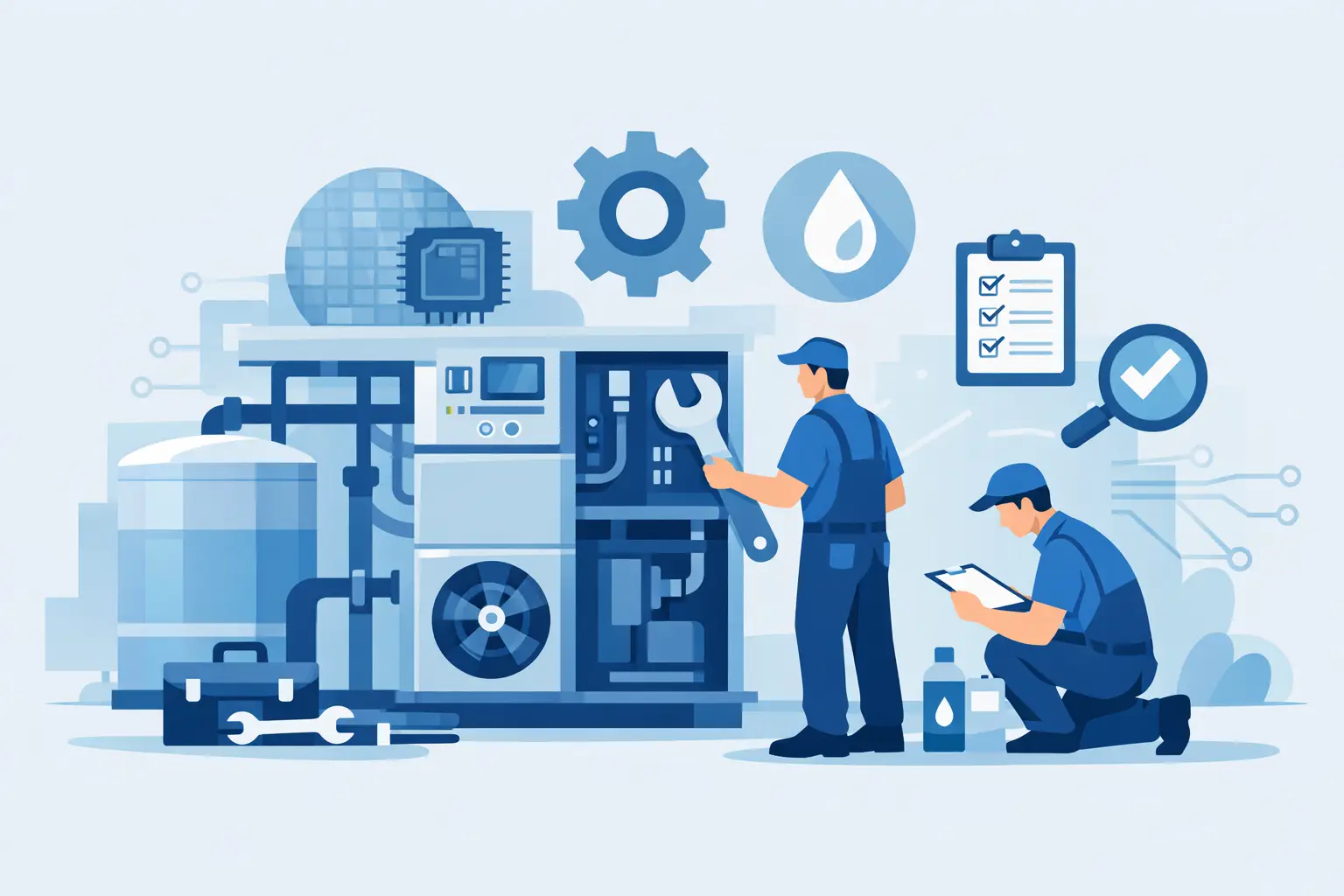
A chiller problem in a semiconductor environment rarely stays small for long. A slight drift in temperature, a pressure issue, or reduced flow can quickly affect process stability, equipment performance, and production output. That is why semiconductor chiller maintenance service is not just a routine facility task. It is a practical way to protect uptime, control operating costs, and reduce the risk of avoidable interruptions.
In semiconductor operations, cooling systems support highly sensitive processes where consistency matters as much as capacity. The goal is not simply to keep equipment cold. It is to keep temperature within a narrow range, maintain clean heat exchange, and make sure the system responds predictably under changing loads. When maintenance is delayed or treated as a basic checklist item, small issues can build into expensive problems.
Why semiconductor chiller maintenance service matters
Semiconductor facilities depend on precision. Chillers often support tools and processes that cannot tolerate unstable temperatures, poor water quality, or fluctuating pressure. Even if the system appears to be running, hidden problems such as fouling, refrigerant imbalance, sensor drift, or pump wear can reduce performance over time.
This is where a proper semiconductor chiller maintenance service makes a difference. The right service approach focuses on reliability, not just breakdown response. It helps identify warning signs early, keeps components operating within design conditions, and extends equipment life without compromising production needs.
There is also a cost angle that should not be ignored. Emergency repairs tend to be more disruptive and more expensive than planned service. A chiller that runs inefficiently may also increase energy consumption month after month. In high-demand environments, that extra operating cost adds up quickly.
What a good maintenance program should cover
Not all chiller maintenance is equal. General cooling knowledge is useful, but semiconductor applications often require a more disciplined service standard. The maintenance plan should reflect the critical nature of the environment, the type of chiller in use, and how tightly the process depends on thermal stability.
Performance checks, not just visual checks
A proper service visit should go beyond looking for obvious leaks or unusual noise. Technicians should review operating temperatures, suction and discharge pressures, flow conditions, control response, and system load behavior. If values are trending away from normal, that may point to a developing issue even before an alarm appears.
Performance-based maintenance is especially valuable in facilities where minor thermal variation can affect process consistency. A unit can be technically operational and still underperform in a way that matters to production.
Heat exchanger and water circuit condition
Heat transfer efficiency is central to chiller performance. Fouling, scaling, or contamination in the water circuit can reduce cooling efficiency and place extra strain on the system. Pumps may work harder, temperatures may become less stable, and components can wear faster.
Maintenance should include inspection of water quality, strainers, piping condition, and heat exchanger cleanliness where applicable. The right interval depends on operating hours, water treatment quality, and the environment. Some systems need more frequent attention than others.
Refrigeration system health
The refrigeration circuit should be checked carefully during semiconductor chiller maintenance service. Refrigerant charge condition, compressor behavior, oil levels where relevant, and control accuracy all affect reliability. If pressures are off or cooling response is slower than expected, the problem may not be obvious without proper measurement.
This is also an area where experience matters. Overcorrecting a charge issue or misreading normal operating behavior can create new problems. A service provider needs to know the difference between a system that is truly failing and one that is reacting normally to load changes.
Controls, sensors, and alarms
Many chiller issues in precision environments come back to controls. A sensor that is slightly out of calibration can create temperature errors that affect the broader process. Alarm history, controller settings, and response timing should be reviewed as part of ongoing maintenance, not only after a fault condition.
For semiconductor facilities, controls are not a secondary concern. They are part of the core cooling performance of the system.
Common signs your chiller needs attention
Some warning signs are easy to spot, while others are more gradual. A rise in energy use, inconsistent leaving water temperature, longer run times, frequent cycling, unusual vibration, or repeated alarms all suggest the system should be checked.
Sometimes the first sign is operational rather than mechanical. Process teams may notice temperature instability before the facilities team sees a clear fault. That is one reason communication between operations and service technicians is so useful. Maintenance works best when it is tied to real-world performance, not just equipment schedules.
If a unit has already needed multiple reactive repairs within a short period, that is another sign the maintenance approach may need to change. Replacing parts without addressing underlying system condition usually leads to repeat issues.
How often should semiconductor chillers be serviced?
It depends on the equipment type, runtime, process criticality, environmental conditions, and water quality management. There is no single schedule that fits every site. A heavily loaded system in a demanding production setting may need more frequent inspections than a lightly loaded backup unit.
That said, waiting for annual service alone is often not enough in high-precision applications. Many facilities benefit from a planned schedule that combines routine inspection, periodic deeper maintenance, and trend monitoring over time. The idea is to create visibility before problems become disruptive.
A good service partner will usually recommend intervals based on actual operating conditions rather than a generic calendar plan. That is the better approach because it balances cost, risk, and equipment needs.
Choosing the right semiconductor chiller maintenance service provider
For critical cooling systems, technical skill matters just as much as responsiveness. You want a provider that can assess system performance accurately, communicate clearly, and work with minimal disruption to the site. Fast response is important, but so is getting the diagnosis right.
The best service support is usually practical and well organized. That means clear maintenance scope, documented findings, sensible recommendations, and technicians who understand both cooling systems and the demands of commercial or industrial environments. In semiconductor settings, attention to detail matters because the margin for error is smaller.
It also helps to work with a company that understands a broad range of cooling applications. A provider with experience across residential, commercial, and specialized industrial systems often brings stronger troubleshooting discipline and more adaptable field knowledge. Easy Cool Engineering supports both everyday cooling needs and more specialized system requirements, which is valuable for customers looking for one dependable partner with real technical depth.
Preventive maintenance versus reactive repair
Reactive repair has its place. Some failures happen suddenly, and immediate support is necessary. But relying on repair alone usually costs more over time, especially in environments where downtime has production consequences.
Preventive maintenance gives you control. It allows service work to be planned around operations, helps reduce emergency callouts, and supports more stable system performance. It will not eliminate every failure, because equipment ages and unexpected issues still happen, but it significantly improves the odds of catching trouble early.
The trade-off is straightforward. Preventive service requires regular investment and coordination. Reactive service may seem simpler in the short term, but it often leads to higher risk and less predictable costs.
What customers should expect from a service visit
A professional maintenance visit should leave you with more than a cleaned unit and a verbal update. You should have a clear sense of system condition, any developing concerns, and whether current performance matches operational needs. If follow-up work is recommended, the reason should be explained in plain terms.
That clarity matters for facilities teams, operations managers, and procurement contacts alike. Good service is not just technical. It is also communicative and dependable. When the cooling system supports critical production, everyone involved needs confidence that maintenance is being handled properly.
Semiconductor cooling does not leave much room for guesswork. A steady, well-maintained chiller supports more than temperature control. It supports uptime, process consistency, and fewer unwanted surprises when production demands are high. If your cooling system is critical to your operation, maintenance should be treated the same way – planned, precise, and handled by people who know what reliable service looks like.
The smartest time to fix chiller risk is before it turns into downtime.