

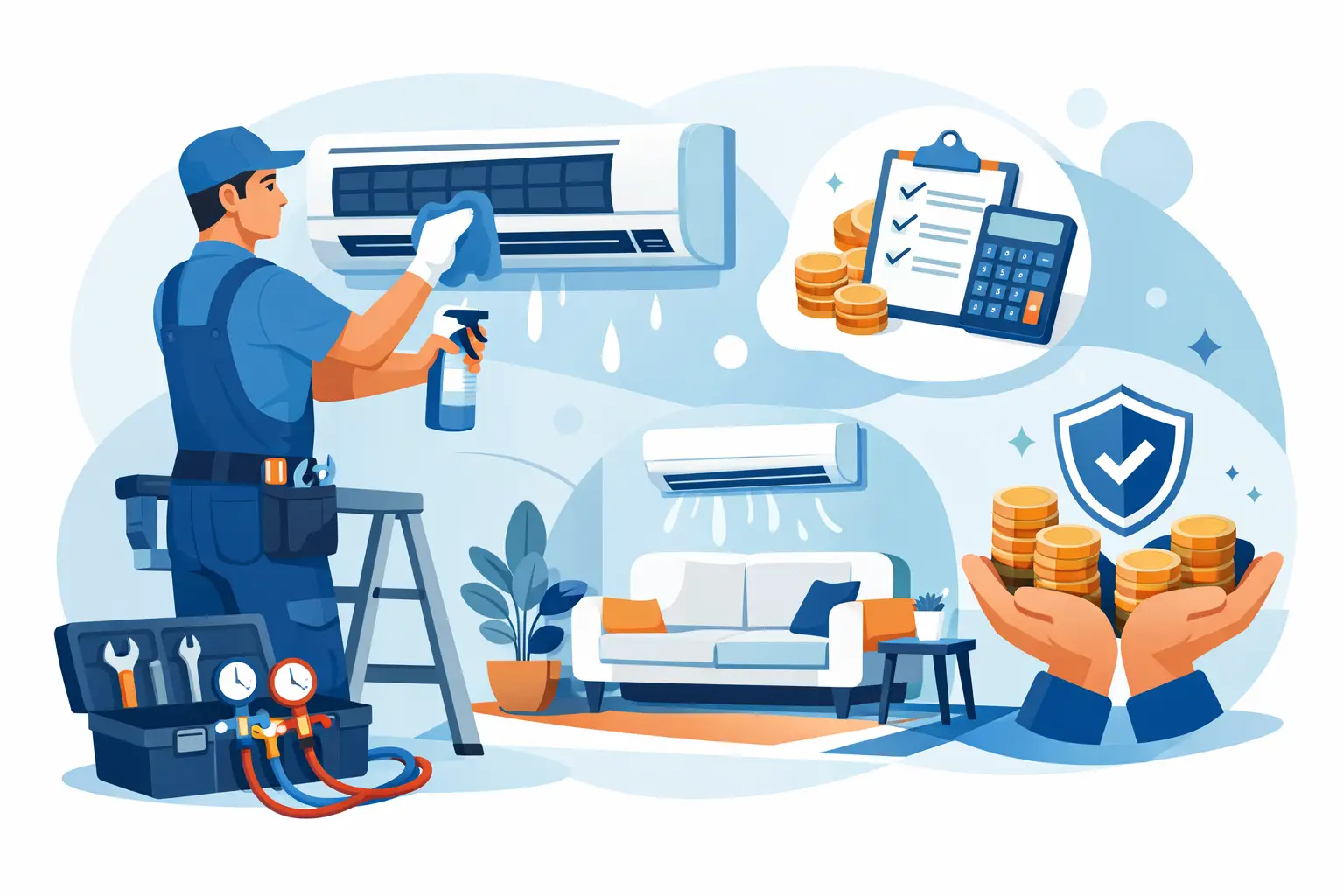
A good aircon servicing package example should make one thing immediately clear: what will be done during each visit, how often the system will be maintained, and what is not included. A low headline price is not especially helpful if it leaves homeowners guessing about coil cleaning, drain treatment, parts, or repair labor after the technician arrives.
For a family home, rental property, or busy office, a service package is meant to reduce surprises. It gives the technician a regular opportunity to spot clogged drainage, weak airflow, dirty filters, unusual noises, and early signs of wear before a small issue becomes a no-cooling call.
What an aircon servicing package should include
Routine servicing is preventive maintenance, not simply a quick visual check. The exact scope depends on the equipment type and condition, but a dependable package generally covers the essential work needed to keep normal air-conditioning systems operating cleanly and efficiently.
During a standard visit, technicians should inspect the indoor and outdoor units, clean accessible filters, check airflow, clean the condensate drain line where appropriate, and assess operating performance. They should also look for water leakage, abnormal vibration, odors, loose electrical connections, and visible signs of refrigerant issues.
A package should state whether the price is per indoor unit, per visit, or for a defined number of systems. This matters in homes with several wall-mounted units and in offices where equipment may include cassette, ducted, split, or VRV systems. A package that works well for two bedroom units may not suit a multi-zone commercial setup.
Just as important, routine servicing should not be presented as a cure for every problem. Chemical washing, deep coil cleaning, refrigerant charging, replacement parts, major drain repairs, and electrical troubleshooting are often separate services. They may be necessary, but they should be recommended based on inspection findings rather than added without explanation.
Aircon servicing package example for a home
The example below illustrates how a residential maintenance plan can be structured. It is not a fixed quote. The right frequency and scope depend on how many units you have, how often they run, whether occupants have allergies, and whether the property has had past leakage or cooling issues.
| Package element | Example scope | |—|—| | Covered equipment | Up to four wall-mounted indoor units and their associated outdoor unit(s) | | Service frequency | Four scheduled visits per year, approximately every three months | | Standard visit work | Filter cleaning, basic indoor-unit cleaning, drainage inspection, performance and airflow checks, and visual electrical inspection | | Condition reporting | Technician notes on leakage risk, unusual noise, cooling performance, and recommended follow-up work | | Scheduling | Advance appointment coordination, with reasonable rescheduling notice | | Not typically included | Chemical wash, parts, refrigerant, repairs, concealed-pipe work, and emergency after-hours attendance |
For many households, quarterly servicing is a practical baseline. It is particularly useful when air conditioners are used daily for sleeping, working from home, or cooling shared living areas. Homes that use only one or two units occasionally may need fewer visits, while households with pets, frequent cooking, or recurring moisture issues may benefit from a closer maintenance schedule.
The value of this kind of package is consistency. Rather than waiting for a unit to leak on a weekend or stop cooling during a heat wave, the homeowner has a planned service cycle and a record of each inspection.
What happens when a problem is found?
A professional package should include clear communication, not automatic upgrades. If a technician identifies a heavily soiled evaporator coil, blocked drain pan, damaged insulation, or a possible refrigerant leak, the next step should be an explanation of the condition, the recommended repair or deep-cleaning option, and the expected cost before additional work begins.
That approach helps customers make informed decisions. A chemical wash may be worthwhile for a unit with persistent water leakage or restricted airflow, but it is not required at every routine visit. Likewise, refrigerant should not be treated as a standard top-up item. If refrigerant is low, the system should be checked for the cause.
Packages for landlords and property managers
Landlords often need a package that does more than maintain equipment. They also need service documentation, predictable scheduling between tenancies, and clear records when tenants report water dripping, poor cooling, or noise.
A useful landlord package may include two to four scheduled visits each year, with an additional inspection before a new tenant moves in. The service report should identify the units checked, note any defects, and separate routine maintenance from repair recommendations. This can make turnover planning easier and help avoid disagreements about whether an issue was pre-existing.
For rental properties, response time can matter as much as the routine schedule. A tenant without cooling may be unable to sleep comfortably or work from home. Before choosing a provider, ask how urgent breakdown requests are handled and whether service appointments can be coordinated directly with the occupant while keeping the owner informed.
Commercial aircon servicing package example
Commercial properties need a more tailored approach because operating hours, occupancy, and equipment design vary widely. An office that runs air conditioning five days a week has different maintenance needs from a restaurant, retail store, server room, or facility with round-the-clock operations.
A commercial package may start with an equipment survey. The provider records the system type, quantity of indoor and outdoor units, access requirements, operating hours, and any areas where downtime must be minimized. From there, the maintenance plan can define service intervals, inspection points, reporting requirements, and escalation procedures.
For example, an office package might provide quarterly maintenance for split or cassette units, including filter and drain checks, coil condition assessment, airflow review, and electrical inspections. A larger facility with VRV or central ACMV equipment may require more detailed performance monitoring and planned work outside business hours.
Commercial clients should also ask whether the package covers documentation for facilities teams. Clear service records are valuable when budgeting for replacements, tracking repeat faults, and demonstrating that equipment has been regularly maintained. For food-service spaces, kitchen duct and ventilation servicing may need to be planned alongside air-conditioning work, but it should be scoped separately because the equipment and cleaning requirements are different.
How to compare package quotes fairly
Comparing only the total price can lead to a poor decision. Two packages may appear similar while covering different numbers of units, visits, cleaning tasks, or reporting standards.
First, confirm the number and type of systems included. A quote for four standard wall units is not directly comparable with one that includes cassette units or difficult-access outdoor condensers. Next, check the visit frequency. An annual package with two visits may be sufficient for light use, but it is not equivalent to quarterly maintenance.
Then review exclusions carefully. Exclusions are not a warning sign by themselves. They are normal when a provider separates routine maintenance from unpredictable repairs and replacement parts. The key is that they are written clearly, with no vague claims that imply every issue will be handled for one flat fee.
Finally, consider service quality and technical capability. Technicians should be able to explain findings in plain language and recommend only the work the system needs. Easy Cool Engineering supports both household systems and more complex commercial cooling requirements, so customers can choose maintenance plans based on their equipment and operating needs rather than a one-size-fits-all checklist.
Choosing the right service interval
There is no single schedule that suits every property. Air conditioners in a lightly occupied home may perform well with less frequent routine servicing, while units that operate daily in bedrooms, offices, retail spaces, or high-traffic areas often need more regular attention.
Start with usage. If units run most nights or throughout the workday, quarterly service is often a sensible starting point. If there is a history of leaks, musty odors, weak airflow, or dust buildup, ask for an assessment rather than simply increasing the number of visits. The underlying cause may require a specific repair or deep cleaning.
The best package is one that gives you a clear maintenance schedule, honest recommendations, and a reliable contact when something changes. That keeps cooling care straightforward and helps your system deliver dependable comfort when you need it most.