

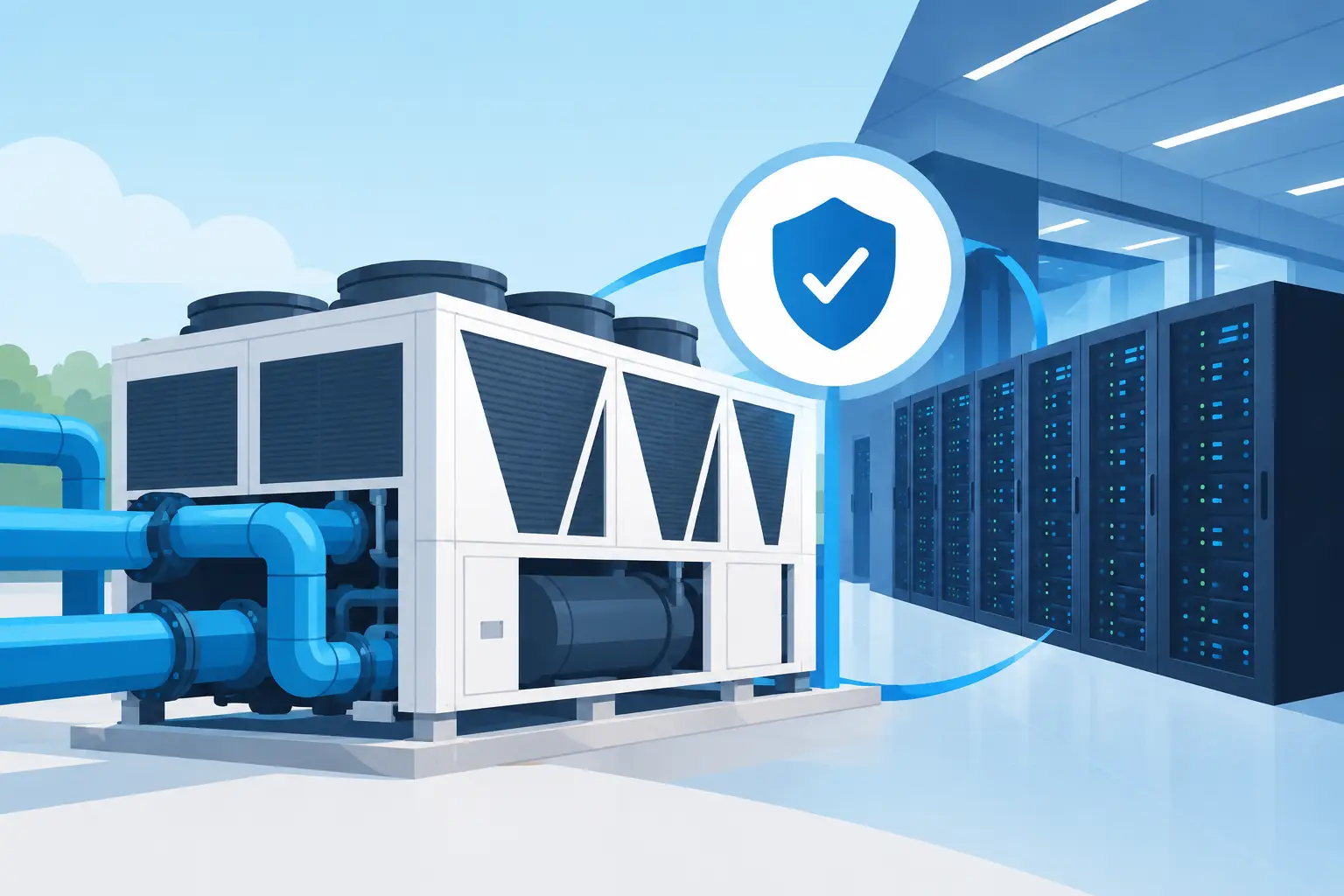
A data center chiller case study is most useful when it shows what happens before a cooling alarm becomes a business interruption. In a mission-critical environment, a chiller does more than produce cold water. It protects servers, networking equipment, storage systems, and the continuity of the operations they support.
The following representative case study reflects a common situation in facilities with aging chilled-water equipment: cooling capacity appeared adequate during normal load periods, but performance became unstable when outside temperatures and IT demand increased at the same time. The objective was not simply to repair a fault. It was to identify the underlying causes, reduce operational risk, and restore predictable cooling performance without disrupting the data center.
The operating problem
The facility operated multiple air-cooled chillers serving computer room air handling units. Operators had reported intermittent high-temperature alerts, longer chiller run times, and occasional lead-lag sequencing issues. None of these symptoms alone had caused a shutdown, but together they created a clear warning sign.
During warmer afternoons, the chilled-water supply temperature drifted above its established setpoint. The backup chiller also started more frequently than expected, even when the calculated cooling load did not appear to require it. This increased electrical consumption and reduced the available redundancy that the site depended on during an equipment failure or maintenance event.
The immediate concern was uptime. The wider concern was that the system was compensating for a problem that had not yet been properly diagnosed. Running all available equipment harder can keep a space cool temporarily, but it is not a long-term reliability strategy.
Data center chiller case study: finding the real cause
The service approach began with a planned inspection rather than an emergency repair. This allowed the engineering team to review operating data, confirm site conditions, and work around the facility’s change-control requirements.
Technicians checked chiller operating pressures, refrigerant conditions, condenser coil cleanliness, pump performance, water temperatures, control signals, and alarm history. They also compared equipment readings against the building management system records. This step mattered because a single temperature reading does not tell the full story. The relationship between supply temperature, return temperature, flow rate, compressor loading, and ambient conditions provides a more accurate picture.
Several contributing issues were found. Condenser coils had accumulated dirt and airborne debris, limiting heat rejection when outdoor temperatures rose. One water-side temperature sensor was reading inconsistently, which affected how the controls interpreted actual system demand. In addition, the lead-lag sequence had been set too aggressively. The standby unit was being called online sooner than necessary, then cycling as load conditions changed.
No single defect explained every symptom. That is common in chiller systems. A slightly fouled coil may not create a critical issue on its own, and a sensor drift may seem minor until it influences automated staging decisions. Together, these conditions reduced efficiency and made the cooling plant less stable during peak periods.
Why a quick reset would not have solved it
Resetting alarms or adjusting a temperature setpoint may have reduced the visible symptoms for a short time. It would not have improved heat transfer at the condenser or corrected the inaccurate control input. It also would have left operators with limited confidence in the remaining redundancy.
For a data center, the question is not only whether the room is cool at this moment. The question is whether the system can maintain required conditions through high ambient temperatures, changing IT loads, and the loss of one component. That is why diagnosis must consider both present performance and failure tolerance.
The corrective work plan
The repair plan was organized to protect operations first. Cleaning and inspection work were scheduled around the facility’s operating window, while control changes were reviewed before implementation. The team confirmed that sufficient temporary capacity and redundancy were available before taking any equipment offline.
The condenser coils were cleaned using an appropriate process that removed buildup without damaging fins. Airflow and heat rejection were then reassessed. The unstable sensor was replaced and verified against calibrated readings. Finally, the control sequence was adjusted so the lead chiller could carry normal demand efficiently while the lag unit remained available for genuine load increases or equipment contingencies.
The controls review also included alarm thresholds and delay settings. A well-configured alarm should give operators enough time to investigate developing conditions, but it must not be so delayed that a real cooling problem goes unnoticed. The correct settings depend on the facility’s thermal design, equipment capacity, expected load profile, and operating procedures.
After the work, technicians monitored supply and return temperatures, compressor cycling, chiller loading, and staging behavior through several operating conditions. The goal was to confirm stable performance, not merely clear the active alarms.
Results that mattered to the facility team
The chilled-water supply temperature returned to its target range and remained more consistent during higher ambient conditions. The lead chiller carried load with fewer unnecessary starts, while the secondary unit returned to a more meaningful standby role. This improved the site’s ability to absorb an unexpected event without immediately operating at reduced redundancy.
Energy performance also improved because the chillers were no longer compensating as heavily for restricted condenser heat transfer and poor control inputs. Exact savings will differ by equipment type, local weather, operating hours, and electrical rates. Still, avoiding excessive compressor cycling and unnecessary staging generally supports lower energy use and reduced wear on critical components.
Equally important, the facilities team gained a clearer maintenance baseline. They could see which readings should be tracked, when cleaning should be scheduled, and which alarms required escalation. That visibility is often as valuable as the repair itself.
What this case study means for data center operators
Chiller reliability is built through disciplined maintenance, accurate controls, and an operating plan that recognizes the value of redundancy. Waiting for a major alarm is rarely the most cost-effective option. By that point, the facility may be forced into urgent work, limited repair choices, or a higher-risk operating position.
A practical maintenance program should include regular coil cleaning, refrigerant and electrical checks, sensor verification, pump and valve assessment, controls testing, and trend review. The required frequency depends on equipment age, site environment, cooling load, and manufacturer recommendations. A clean indoor environment does not always mean the outdoor condenser section is protected from dust, pollution, leaves, or construction debris.
Facilities should also treat recurring minor alarms as useful evidence. If a high-temperature alert appears only during certain hours, if a standby chiller starts unexpectedly, or if cooling output varies despite similar loads, those patterns deserve investigation. Small deviations can reveal problems while there is still time to plan repairs properly.
Questions to ask before approving chiller work
When reviewing a chiller service proposal, operators should ask whether the diagnosis includes system conditions rather than only the reported fault. They should also confirm how work will protect uptime, what readings will be verified afterward, and whether any controls changes will be documented.
It is reasonable to ask for clear explanations instead of technical jargon. A capable cooling partner should be able to explain what was found, why it affects reliability, what work is recommended now, and what can be monitored over time. This is especially important in high-precision environments where cooling decisions affect more than comfort.
Easy Cool Engineering supports specialized chiller service with a practical, responsive approach focused on system performance and operational continuity. For data center and critical facility teams, the right service plan is one that addresses immediate issues while making the next cooling decision easier, safer, and more predictable.
The most helpful time to investigate chiller performance is when the system is still meeting demand, but the trends suggest it is working harder than it should. That is the point where planned maintenance can protect capacity, preserve redundancy, and keep a manageable issue from becoming an outage.