

Choosing air conditioning gets expensive fast when the wrong system is installed for the wrong space. That is why the split system vs central aircon question matters more than most people expect. The best option is not always the biggest system or the one with the lowest upfront price. It is the one that fits your layout, usage pattern, budget, and long-term maintenance needs.
For homeowners, the choice often comes down to comfort in a condo, apartment, or landed home. For landlords and commercial operators, the bigger concern may be installation complexity, energy use across multiple rooms, and service access over time. Both systems can cool well. The difference is how they do it, what they cost to run, and how practical they are for your property.
Split system vs central aircon: the core difference
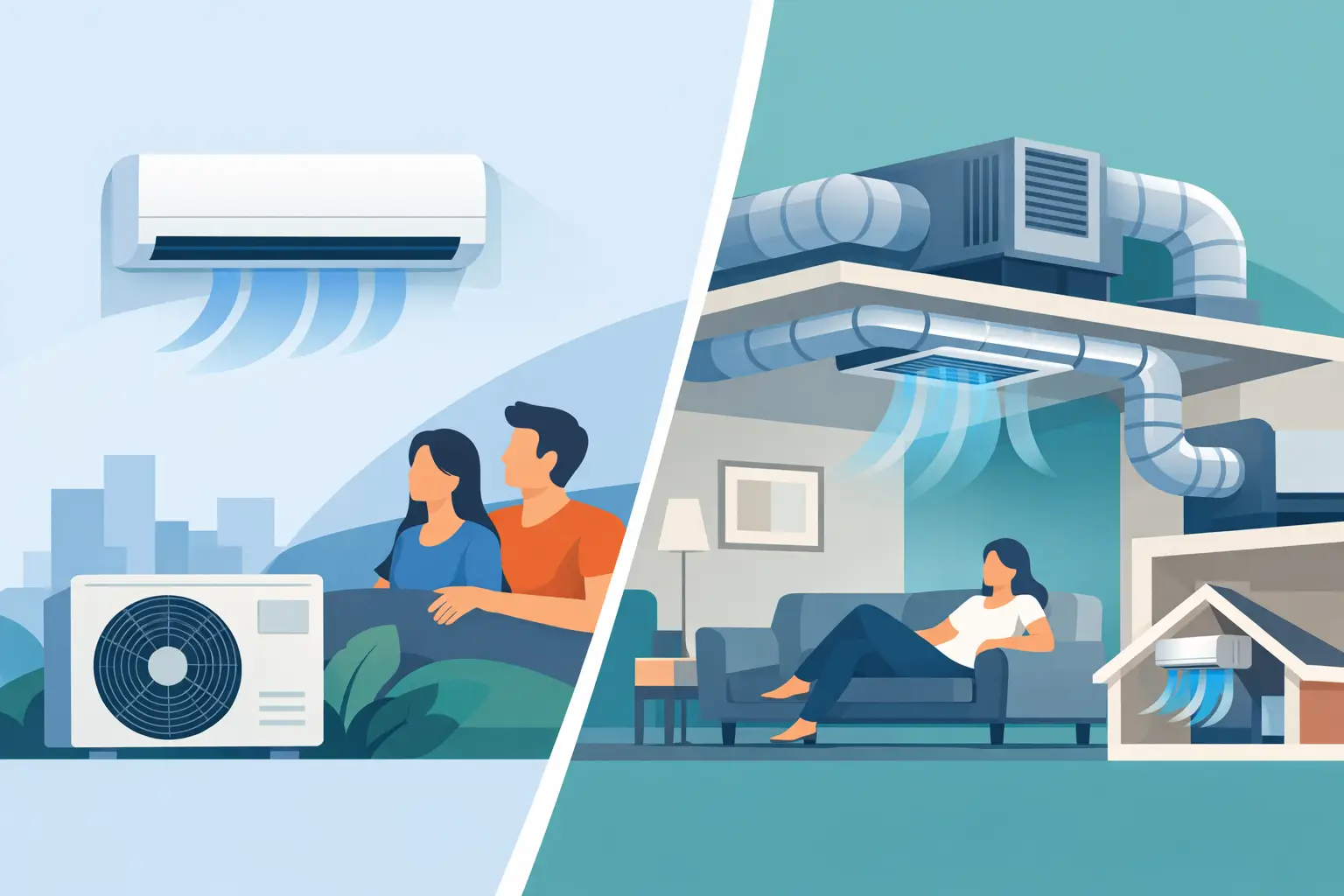
A split system air conditioner cools a specific room or zone using an indoor unit connected to an outdoor condenser. You may have one unit for a bedroom, another for a living room, and separate controls for each space. This setup is common in apartments, smaller homes, and properties where different rooms are used at different times.
Central aircon uses one main system to cool the whole home or a large section of it through ducts and vents. Air is distributed from a central unit, usually with one thermostat or a zoned control setup if the system is more advanced. This is often seen in larger houses, office environments, and buildings designed with ductwork from the start.
The simplest way to think about it is this: split systems cool room by room, while central air cools the property as a connected whole.
When a split system makes more sense
A split system is often the practical choice when you do not need to cool every room at the same time. If the family spends evenings in the living room, sleeps in two bedrooms, and rarely uses the guest room, there is little value in pushing cooled air through the entire home.
This approach gives better control. One person can keep a bedroom cooler while another keeps a home office at a different setting. That flexibility usually helps with energy savings because you only run the rooms you actually use.
Installation is often simpler too, especially in existing homes without ducts. You avoid major renovation work, ceiling modifications, and the added cost of building out duct routes. In many residential properties, that alone makes split systems the more realistic option.
There are trade-offs. A home with several indoor units will have more visible wall-mounted equipment. Some people do not like the appearance. Maintenance can also become more repetitive because each indoor unit needs regular cleaning and servicing to keep airflow, drainage, and cooling performance in good condition.
When central aircon is the better fit
Central aircon is usually the stronger option when consistent whole-home cooling matters. In a larger house with open common areas, multiple occupied rooms, and a preference for a cleaner interior look, a central system can feel more integrated and less cluttered.
Because cooled air is delivered through vents, the visual impact inside the room is minimal. That matters to homeowners who care about aesthetics and to commercial spaces where a cleaner ceiling or wall layout supports the overall design.
Central systems can also perform well in properties where the building envelope and duct design are properly planned. When matched correctly to the space, they provide even cooling and a more uniform temperature experience across rooms.
The downside is that central air typically demands more planning, more installation work, and a higher upfront budget. If ducts are poorly designed, leaking, or badly insulated, energy performance can suffer. Repairs may also be less straightforward because problems can involve the air handler, ducts, dampers, thermostat controls, or airflow balancing across the system.
Cost is not just the purchase price
Many buyers compare quotes and focus on the installation figure first. That matters, but it should not be the only number driving the decision.
Split systems often cost less to install in smaller or mid-sized properties, especially when there is no existing ductwork. The project is usually more contained, and expansion can happen in stages if more rooms need cooling later.
Central air often carries a higher initial cost because of equipment size, ductwork requirements, labor, and design complexity. In a new build or a property already set up for ducts, the cost gap may be smaller. In a retrofit, it can be much larger.
Operating cost depends heavily on usage habits. If you cool only a few rooms at a time, split systems often come out ahead. If the entire property needs cooling regularly for long stretches, a well-designed central system may be more efficient in practice than running several separate units all day.
That is why there is no honest one-size-fits-all answer. The winning option depends on how the space is actually used.
Energy efficiency and comfort are linked
People often ask which system is more efficient, but efficiency without comfort is not very helpful. A system that technically uses less power but cools unevenly, cycles poorly, or struggles during peak heat will not feel like a good investment.
Split systems tend to be efficient for targeted cooling. They reduce wasted energy in empty rooms and give direct control over each zone. This is especially useful for households with varying schedules or for office layouts where some rooms sit unused for part of the day.
Central air can be efficient too, particularly in larger properties where broad coverage is needed and the duct system is properly sealed and sized. If zoning is built in, comfort improves further because the system does not have to treat every area exactly the same.
The weak point for central systems is duct loss. If cooled air escapes before it reaches the rooms, the system works harder than it should. The weak point for split systems is overuse of multiple units without proper sizing or upkeep, which can chip away at the savings people expect.
Installation and property type matter a lot
This is where the split system vs central aircon decision becomes less theoretical and more practical.
If you own a condo, apartment, or townhouse with limited renovation flexibility, split systems are often easier to install and easier to phase. They suit urban living well because they cool the spaces people use most without requiring a full structural rethink.
If you have a large detached home or are planning HVAC for a new construction project, central air may deserve a closer look. It can offer better integration when the property is designed around it from the beginning.
For commercial settings, the answer depends on layout and operational needs. A small retail unit or a series of enclosed offices may work well with split systems. A larger office floor, showroom, or facility with a uniform cooling load may benefit more from a central or broader ACMV approach. In these cases, system design quality matters just as much as system type.
Maintenance is where long-term value shows up
Air conditioning is not a set-and-forget investment. The system that looks cheaper at the start can become the more expensive one if servicing is neglected or access is difficult.
Split systems need regular filter cleaning, coil checks, drainage maintenance, and performance testing for each indoor unit. If a property has four or five indoor units, the servicing scope grows with it. The benefit is that a fault in one room does not necessarily affect the entire property.
Central air maintenance focuses on the main equipment, filters, ducts, drain lines, and airflow performance. When problems happen, they can affect broader areas at once. On the other hand, there may be fewer visible indoor components to maintain room by room.
What matters most is choosing a setup your service provider can support reliably over time. A dependable installer will look beyond equipment brand and talk honestly about access, cleaning frequency, parts, and expected upkeep. That is where experienced companies such as Easy Cool Engineering often add real value – not just by installing a system, but by matching it to the property and supporting it properly afterward.
Which should you choose?
If your priority is flexible room-by-room cooling, simpler retrofitting, and better control over which spaces use energy, a split system is usually the stronger choice. If your priority is whole-home coverage, cleaner interior aesthetics, and integrated cooling for a larger property, central air may be the better investment.
The right answer depends on square footage, occupancy, layout, insulation, budget, and how often the entire space needs cooling. A small household that uses only part of the home most days should not be pushed toward a system built for full-property cooling. At the same time, a large busy property may outgrow a patchwork approach of separate units.
A good cooling decision should make daily life easier, not just look good on a quote. If you compare your actual usage before you compare equipment, the better choice usually becomes clear.