

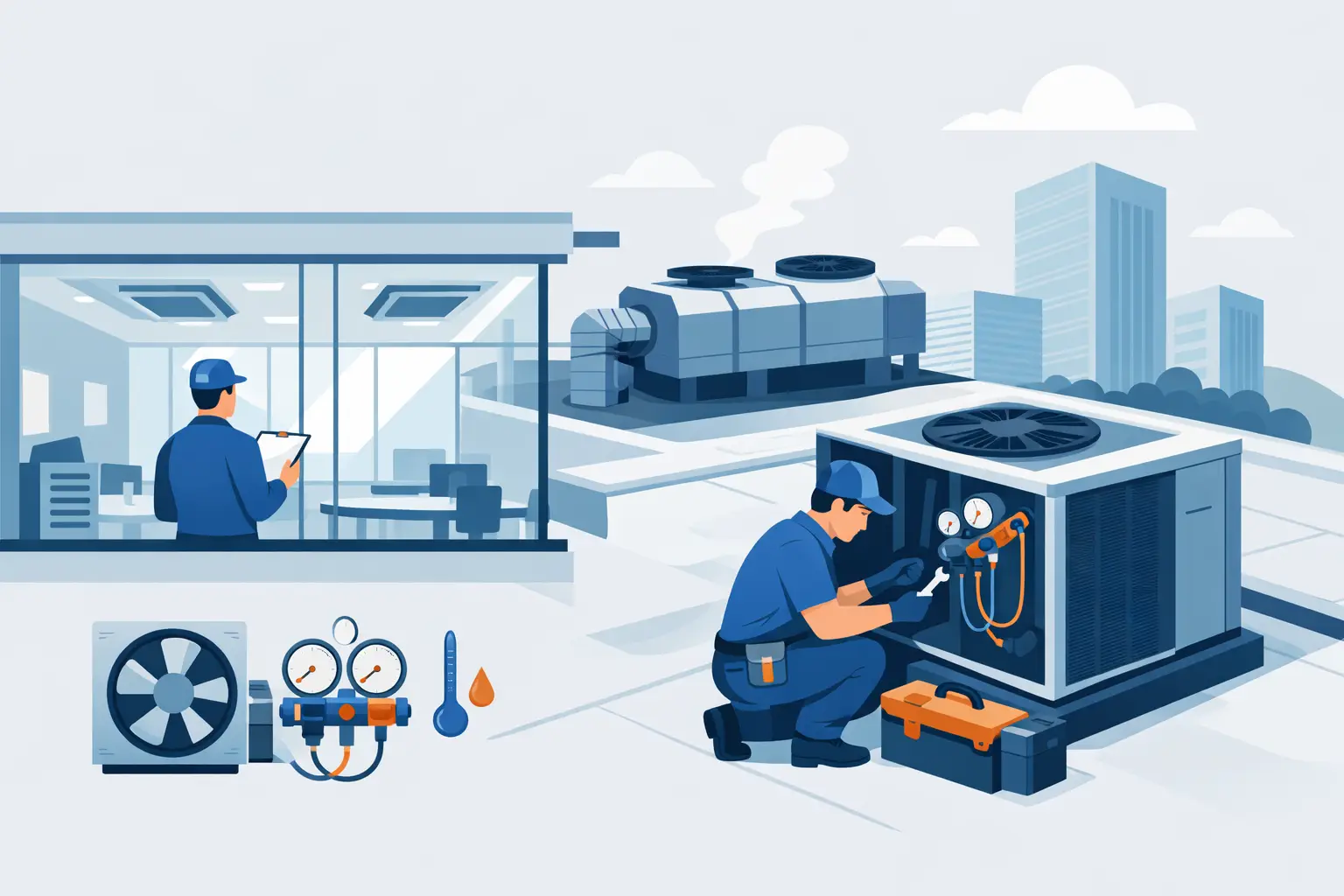
A commercial tenant complains that one meeting room is freezing, another is stuffy, and the monthly utility bill keeps climbing. That is usually how a commercial acmv maintenance guide becomes urgent instead of optional. In most buildings, poor ACMV upkeep does not fail all at once. It shows up slowly through uneven cooling, more frequent callouts, indoor air complaints, and systems that work harder than they should.
For offices, retail spaces, food-service sites, and larger facilities, maintenance is not just about keeping rooms comfortable. It affects equipment life, energy use, occupant experience, and business continuity. A good plan helps you catch small issues before they turn into shutdowns, damaged components, or expensive emergency repairs.
What commercial ACMV maintenance actually covers
ACMV stands for air conditioning and mechanical ventilation. In a commercial setting, that usually means more than a few indoor units and thermostats. It can include air handling units, fan coil units, condensers, chilled water systems, ventilation fans, ductwork, controls, filters, drainage, and sometimes kitchen exhaust or specialized cooling support depending on the site.
That matters because commercial maintenance is not one task. It is a coordinated process that keeps cooling, airflow, humidity control, and ventilation working together. A unit can still produce cold air while the broader ACMV system is already under strain. Dirty coils, poor drainage, sensor drift, clogged filters, and airflow imbalance can all reduce performance long before a total breakdown happens.
Why a commercial ACMV maintenance guide matters
Commercial systems operate longer hours, serve more people, and often face more varied demand than residential systems. An office may need stable cooling during business hours, a retail space may deal with door openings and changing occupancy, and a restaurant may carry a heavy ventilation load. Each environment puts different pressure on the system.
That is why a commercial ACMV maintenance guide should not be treated like a generic checklist. The right schedule depends on equipment type, operating hours, occupancy, dust load, and whether the site needs close temperature control. A lightly used office suite and a busy back-of-house food-service area should not be maintained the same way.
The trade-off is simple. More frequent servicing costs more upfront, but delayed maintenance often costs more later through energy waste, tenant complaints, shorter equipment life, and unplanned repairs. The right balance depends on how critical cooling is to your operation.
The maintenance schedule that works for most commercial sites
Most commercial sites benefit from a monthly visual review, quarterly servicing, and a deeper annual inspection. That does not mean every component needs the same attention at the same interval. Filters may need more frequent replacement in dusty environments, while controls and calibration checks may follow a different schedule.
A monthly review usually focuses on visible issues. This includes checking for unusual noise, poor drainage, water stains, blocked return or supply air paths, thermostat complaints, and obvious drops in cooling performance. These are fast checks, but they often catch the first signs of trouble.
Quarterly maintenance is where routine system care should happen. This often includes cleaning filters, checking coils, inspecting belts and motors where applicable, testing drain lines, reviewing operating pressures, confirming airflow, and checking electrical connections. For many commercial operators, this is the interval that gives the best balance between cost control and performance.
An annual inspection should go further. It is the right time to review overall system condition, check whether equipment is still meeting the space load, look for recurring faults, inspect duct condition, verify controls, and identify parts that are wearing out before peak demand season. If your building has mission-critical spaces, annual planning should also include contingency discussions.
Key tasks in a commercial ACMV maintenance guide
A useful commercial ACMV maintenance guide should focus on the tasks that have the biggest impact on reliability and operating cost.
Filter management is one of the most basic and most overlooked items. Dirty filters reduce airflow, increase fan strain, and make cooling less effective. In a commercial environment, this can quickly affect comfort across multiple rooms or zones.
Coil cleaning is just as important. Evaporator and condenser coils lose efficiency when dirt builds up. That buildup forces the system to work harder, and over time it can drive up utility costs and contribute to component wear.
Drain inspection matters because blocked or poorly draining systems can lead to water leaks, staining, odors, and even ceiling or finish damage. In commercial spaces, a minor drainage issue can quickly become a tenant-facing problem.
Electrical and control checks are another critical area. Loose connections, failing capacitors, worn contactors, or inaccurate sensors can cause erratic behavior that looks like a cooling issue but is really a control issue. Catching this early helps avoid larger failures.
Airflow verification is often underestimated. If diffusers are blocked, dampers are out of position, or fans are underperforming, the space may feel poorly cooled even when the equipment itself is functioning. Good maintenance should confirm not only that the system runs, but that air is reaching the right places in the right volume.
Warning signs you should not ignore
Commercial systems rarely fail without warning. The problem is that early signs are easy to dismiss when the building is still partly comfortable.
One common sign is inconsistent temperature between zones. If one area is always warmer or colder than the rest, it may point to airflow imbalance, a control issue, dirty components, or a system that is no longer matched well to the space.
Another sign is rising energy cost without an obvious operating change. When equipment runs longer to achieve the same result, maintenance should be one of the first things reviewed.
Frequent tenant or staff complaints also matter. Complaints about stale air, humidity, stuffiness, or overcooling often signal issues that go beyond simple thermostat adjustment. In some cases, the cooling equipment is fine but ventilation performance is not.
Short cycling, unusual sounds, water leaks, musty odors, and repeated tripping are all signs that should be addressed early. Waiting for a complete shutdown usually means the repair scope and business disruption will be greater.
How to make maintenance practical, not reactive
The best maintenance plans are simple enough to follow consistently. Start by grouping equipment by location, type, and criticality. A comfort cooling unit in a small admin room does not need the same response priority as a system serving a customer-facing sales floor or a temperature-sensitive production area.
Keep a service record for each system. That record should track filter changes, coil cleaning, drainage issues, recurring alarms, part replacements, and major repairs. Patterns matter. If the same unit keeps showing the same fault, the answer may not be another routine service visit. It may be time to address the root cause.
It also helps to assign a clear reporting path inside your team. Staff should know what to report, who receives the report, and how urgent issues are escalated. A leaking cassette unit and a warm pantry are not the same priority, and your process should reflect that.
For many facilities, planned maintenance works best when paired with a trusted service partner that can handle both routine servicing and more technical ACMV support. That reduces delays when a minor issue turns into a deeper repair need.
Choosing the right service level
Not every commercial site needs the same maintenance intensity. A small office with standard occupancy may do well with a straightforward preventive schedule. A retail or food-service environment may require more frequent attention because of traffic, heat load, or ventilation demands. Industrial spaces and critical environments often need tighter monitoring and a stronger response plan.
The right question is not just how often maintenance should happen. It is what failure would cost your business if it happened at the wrong time. If downtime affects customers, tenant satisfaction, operations, or sensitive equipment, a more proactive plan usually makes sense.
At Easy Cool Engineering Pte Ltd, that practical approach is what matters most – maintenance that fits the site, reduces disruption, and supports reliable day-to-day operation instead of forcing customers into a one-size-fits-all schedule.
A better standard for long-term performance
Commercial ACMV maintenance works best when it is treated as an operating discipline, not a last-minute fix. Clean filters and serviced units are only part of the picture. The real value comes from consistent checks, accurate diagnosis, and a maintenance plan that matches how your building actually runs.
If your site has recurring hot spots, unexplained utility increases, or systems that seem to need constant attention, that is usually the right time to review the maintenance approach rather than wait for the next failure. A steady, well-managed ACMV program keeps comfort predictable, protects equipment, and makes daily operations easier for everyone who depends on the space.