

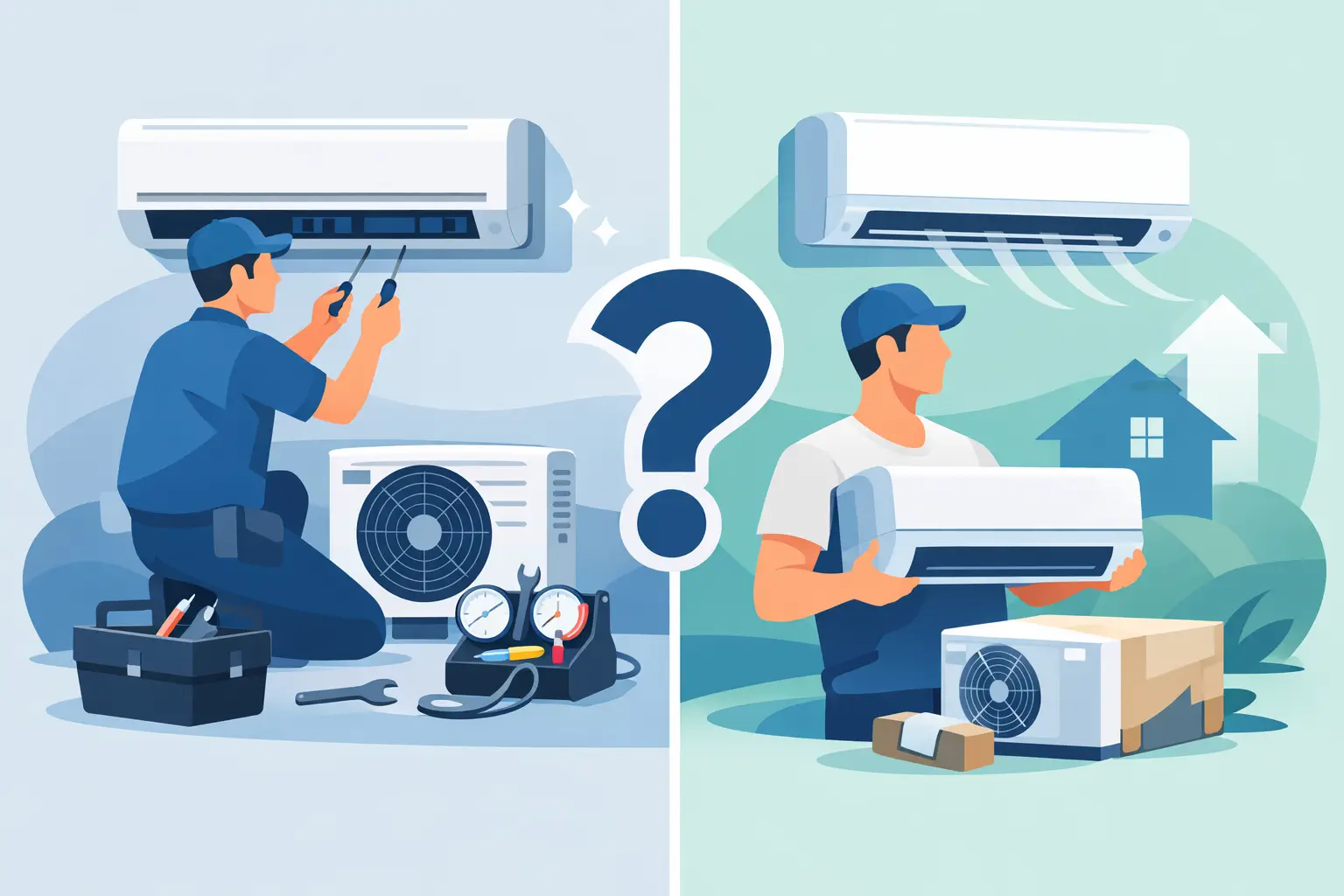
Your air conditioner rarely fails at a convenient time. It usually starts with weak airflow on a hot afternoon, unusual noise at night, or rising utility bills that make you wonder whether you need aircon repair or replacement.
That decision is not always straightforward. A quick fix can restore performance and save money, but there are cases where another repair only delays a larger and more expensive problem. For homeowners, landlords, and businesses, the best choice comes down to the age of the system, the nature of the fault, operating efficiency, and how reliable the unit needs to be day after day.
How to decide on aircon repair or replacement
The first question is simple: is the problem isolated, or is it part of a pattern? If your system has been running well for years and suddenly develops a clogged drain line, dirty coil, faulty capacitor, or thermostat issue, repair is often the practical choice. These are common problems, and when handled properly, they can restore cooling without the cost of a full system change.
Replacement becomes more likely when the unit has repeated breakdowns, struggles to cool evenly, or shows signs of major component wear. A compressor issue, refrigerant leak in an older system, or severe corrosion may cost enough that investing more into the same unit stops making financial sense. In those situations, replacing the system can reduce future service calls and improve day-to-day comfort.
A good service assessment should look beyond the immediate symptom. It should also consider how the system has been performing overall, whether repairs are becoming more frequent, and whether the equipment still suits the size and usage of the space.
When repair makes the most sense
Repair is usually the better route when the unit is still within a reasonable service life and the issue is clearly defined. Many air conditioning problems are caused by wear parts, blocked components, electrical faults, or maintenance-related buildup. These can often be resolved without replacing the full system.
For residential customers, repair is often worthwhile if the system is under 8 to 10 years old and has otherwise been dependable. A single repair bill is easier to justify when the unit still cools well, replacement parts are available, and energy use remains acceptable. The same logic applies in offices or small commercial spaces where downtime is manageable and the system has not become a recurring operational problem.
Repair may also be the right short-term choice when budget timing matters. If a customer needs cooling restored quickly and the system can safely continue operating after service, repair can buy time to plan for replacement later. That is especially helpful for landlords coordinating tenancy schedules or businesses trying to avoid disruption during peak operating periods.
Still, a repair should solve a real problem, not just postpone failure for a few weeks. If the unit has a long list of unresolved issues, the lowest immediate cost is not always the best value.
Signs a repair is still worth it
A professional repair is often reasonable when the system cools normally after service, the fault is limited to one component, and the repair cost is small compared with the value of the unit. If noise, airflow, or temperature problems appeared recently rather than over many months, that is another sign the issue may be contained.
Maintenance history matters too. Systems that have been cleaned and serviced regularly tend to respond better to repair because the rest of the equipment is usually in healthier condition.
When replacement is the smarter long-term move
Air conditioning systems do not usually fail all at once. More often, they become expensive, inefficient, and unreliable before they stop completely. That is where replacement starts to make more sense than another repair.
Age is one of the clearest indicators. If the system is 12 to 15 years old or older, major repairs deserve closer scrutiny. Even if one part can be replaced, another aging component may fail next. Putting money into an older unit can feel cheaper in the moment, but repeated repairs often add up quickly.
Efficiency is another factor. Older systems typically consume more power and may struggle to maintain stable indoor temperatures. In homes, that means less comfort and higher monthly bills. In commercial settings, poor cooling performance can affect staff comfort, customer experience, equipment reliability, or business operations.
Replacement is also worth considering when the system is no longer sized correctly for the space. Renovations, room layout changes, increased occupancy, or heavier cooling loads can all expose limitations in an existing unit. In that case, replacing the equipment is not just about fixing a fault. It is about matching the cooling solution to current needs.
Signs aircon replacement is likely the better choice
If your unit needs frequent service, uses outdated refrigerant, leaks repeatedly, produces inconsistent cooling, or has a major compressor problem, replacement often becomes the more dependable option. The same applies when parts are difficult to source or repair costs approach a large percentage of the price of a new system.
For businesses and facilities with low tolerance for downtime, reliability can outweigh repair savings. A system that fails at the wrong time can disrupt operations far more than the cost difference between repair and replacement.
Cost is important, but so is value
Most customers begin with cost, and that is understandable. Repair usually has a lower upfront price, while replacement requires more planning and investment. But the better question is not only what costs less today. It is what gives better value over the next few years.
A modest repair on a relatively young unit can be excellent value. A major repair on an old system with declining efficiency may not be. If the unit needs another service visit soon after, the total cost rises while confidence in the system drops.
Energy use also matters. A newer system may lower operating costs, cool more consistently, and reduce strain during heavy usage. Over time, those savings can help offset the initial replacement expense. That is particularly relevant in warm climates, high-use households, retail environments, and commercial sites where air conditioning runs for long hours.
This is why a proper recommendation should compare likely near-term repair costs, remaining equipment life, and expected operating performance. The cheapest path is not always the most economical one.
Residential and commercial needs are not the same
For homeowners, comfort, noise level, and monthly utility costs are usually the biggest concerns. Families often want the quickest path back to reliable cooling without overpaying. In that case, a clear diagnosis and honest recommendation matter more than a hard sell in either direction.
Landlords may look at things differently. They need dependable cooling for tenants, but they also need to manage property costs responsibly. If a repair can restore reliable operation, it may be the right move. If breakdowns are becoming frequent, replacement may be the better way to avoid repeated callouts and tenant complaints.
Commercial clients often have a wider set of considerations. Offices, food-service businesses, retail spaces, and facilities teams need cooling systems that support operations with minimal interruption. In these settings, reliability, response time, and lifecycle cost often matter more than the lowest invoice amount. A technically capable service partner can help assess whether repair remains viable or whether replacement will better support long-term performance.
What a proper professional assessment should include
The right recommendation should never be based on guesswork. A qualified technician should inspect the full condition of the system, not just the visible symptom. That includes airflow, electrical components, refrigerant performance, drainage, coil condition, compressor health, and overall cooling output.
They should also ask practical questions. How old is the unit? How often has it needed service? Has your electricity use gone up? Are some rooms warmer than others? Is the system serving a home, rental unit, office, or more demanding commercial space? These details affect whether repair or replacement is the better choice.
At Easy Cool Engineering Pte Ltd, that kind of practical, customer-focused assessment is what matters most. The goal is not to push the biggest job. It is to recommend the option that restores dependable cooling with the right balance of cost, performance, and long-term value.
The best time to act is before complete failure
Many customers wait until the system stops entirely. By then, the decision feels urgent, options feel limited, and downtime becomes more stressful than it needed to be. If your air conditioner is showing warning signs now, it is worth getting it assessed before a minor issue grows into a major one.
A good repair can extend the life of a healthy unit. A timely replacement can prevent repeat costs and improve reliability. The right choice depends on the condition of the system, the demands of the space, and how much risk you are willing to carry when cooling matters most.
If your air conditioner has been giving you reasons to doubt it, that is usually the right moment to stop guessing and get a clear answer.