

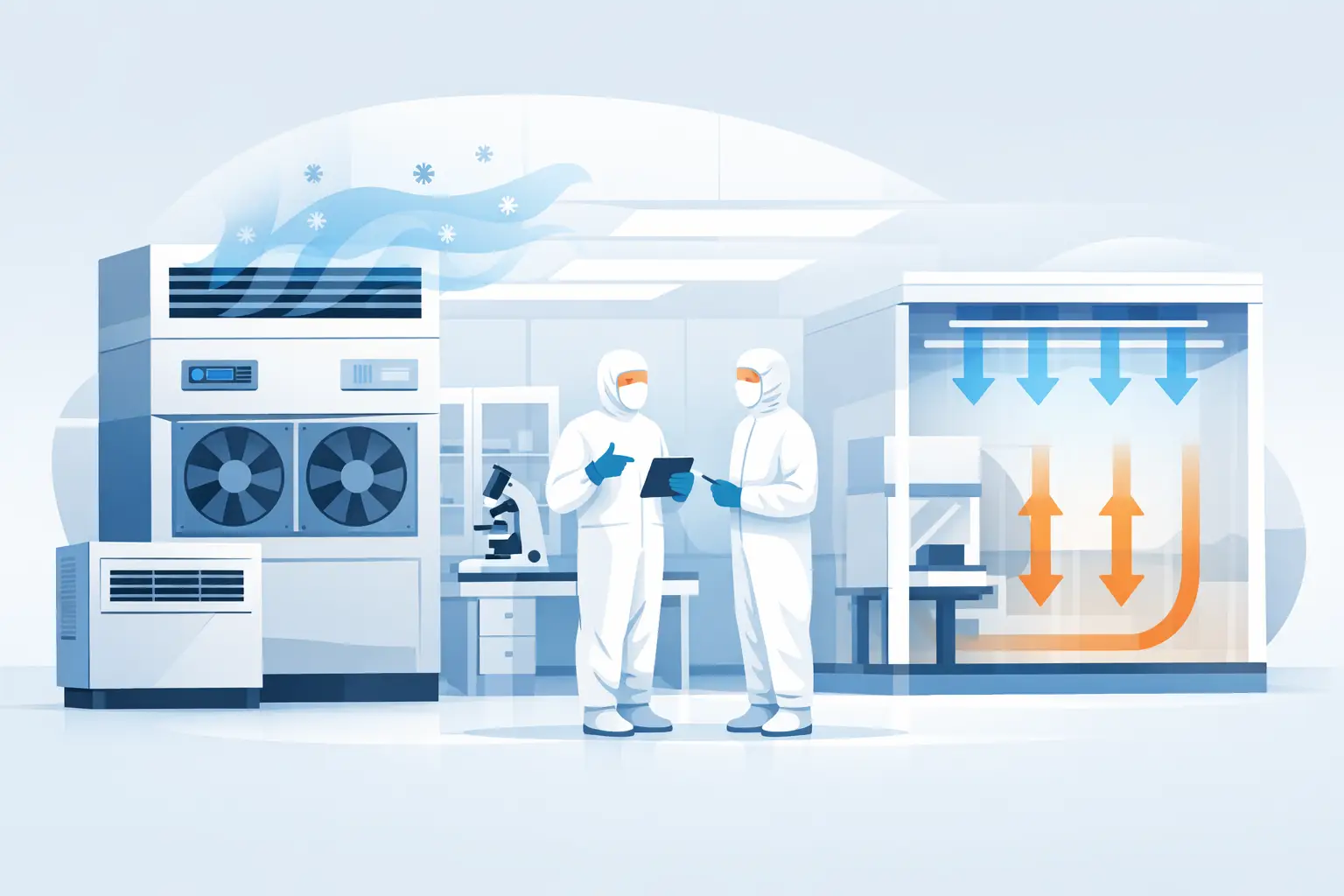
A cleanroom can meet particle-count targets and still fail where it matters most. If temperature shifts, humidity drifts, or airflow loses balance, product quality, yield, and compliance can all take a hit. That is why precision cooling for cleanrooms is not just about keeping a space cold. It is about keeping the entire environment stable, predictable, and fit for the process inside it.
For facility managers, operations teams, and manufacturers, the challenge is rarely a single number on a thermostat. Cleanrooms support sensitive work in semiconductor production, electronics, pharmaceuticals, medical devices, and other controlled environments where small changes create expensive consequences. A cooling setup that works well in a standard commercial space may not be suitable here. Cleanrooms need tighter control, better monitoring, and equipment that can respond without creating new problems.
What precision cooling for cleanrooms really means
Precision cooling for cleanrooms refers to environmental control designed for tight tolerances, continuous operation, and process stability. The goal is not simply comfort. It is to maintain temperature, humidity, pressure relationships, and airflow patterns within the required operating range for the room classification and the work being done.
That difference matters. In an office, a short temperature swing may be inconvenient. In a cleanroom, it can affect static control, material behavior, equipment performance, calibration accuracy, and contamination risk. If humidity rises too far, condensation or microbial concerns may follow in some applications. If it drops too low, electrostatic discharge becomes a bigger threat. If airflow changes unexpectedly, particles may move in ways the room was designed to prevent.
Precision systems are built to manage those variables more closely than standard comfort cooling systems. They are also expected to run reliably under demanding loads, often around the clock.
Why cleanrooms need more than standard air conditioning
A standard split unit or basic packaged system can cool a room, but cleanrooms place very different demands on the HVAC infrastructure. Air changes are higher. Filtration is tighter. Internal heat loads may fluctuate based on equipment, lighting, occupancy, and process cycles. Some rooms require strict positive or negative pressure relative to adjacent spaces. Others need a narrow humidity range that standard systems struggle to maintain.
There is also the issue of consistency. A comfort cooling system may satisfy average conditions across the day, but cleanrooms are judged by how well they hold the line during peak loads, startup periods, seasonal shifts, and equipment changes. That is where precision equipment, proper controls, and careful system integration become essential.
The trade-off is cost and complexity. Precision cooling systems typically require more planning, more coordination with cleanroom design, and more disciplined maintenance. But for critical environments, that investment is often far less costly than downtime, rejected product, or failed audits.
The core conditions that must stay under control
Temperature usually gets the most attention first, but it is only one part of the picture. In many cleanrooms, a stable temperature supports both process quality and worker performance. The acceptable range depends on the application. Semiconductor and electronics environments often require tighter tolerances than general-purpose controlled spaces.
Humidity control is equally important. It affects static electricity, product integrity, process repeatability, and even how certain materials are handled or stored. Holding a room at the right humidity level often requires more than cooling capacity alone. Reheat, dehumidification strategy, and sensor accuracy all matter.
Airflow is another major factor. Cleanrooms depend on controlled air distribution to manage particles and protect work zones. If cooling equipment disrupts that pattern with poor diffuser placement, uneven velocity, or unstable volume control, the room may perform below spec even when temperature readings look acceptable.
Pressure control adds another layer. Rooms are often designed to maintain directional airflow between cleaner and less-clean areas. A cooling system that is not coordinated with make-up air, exhaust, and filtration can upset these pressure relationships.
Design decisions that affect cleanroom performance
The best results come from treating cooling as part of the cleanroom system, not as an add-on. Equipment selection should reflect the room classification, process sensitivity, internal heat gains, occupancy, hours of operation, and redundancy requirements.
Load calculation is one of the first places where errors happen. In cleanrooms, sensible and latent loads are not always straightforward. Process equipment, recirculation fans, lighting, and envelope conditions all contribute. If the design underestimates load, the room may never stabilize properly. If it oversizes equipment too much, short cycling and poor humidity control can follow.
Controls also deserve close attention. Precision cooling depends on sensors, staging logic, and response times that match the environment. A capable unit with weak control strategy can still produce unstable conditions. Good controls should allow operators to monitor trends, respond to alarms quickly, and make adjustments without guesswork.
Redundancy is often worth considering. Not every cleanroom needs full N+1 design, but critical production areas may need backup capacity or failover planning. The right level depends on the cost of downtime and how quickly operations can recover from an interruption.
Precision cooling for cleanrooms in high-tech environments
Some environments place especially high demands on cooling stability. Semiconductor spaces are a good example. Even small environmental variations can affect process performance, yield, and equipment reliability. Heat loads can be dense and localized, and system uptime is closely tied to production continuity.
In these settings, precision cooling for cleanrooms often works alongside chillers, ACMV infrastructure, and specialized air handling strategies. The focus is not only room-level comfort or compliance. It is process support. That may mean tighter control bands, stronger monitoring, and maintenance practices that reduce risk before a problem affects the line.
This is also where service capability matters. A contractor who only understands standard commercial air conditioning may not be equipped to support a mission-critical cleanroom. The technical depth behind installation, maintenance, troubleshooting, and system balancing makes a real difference.
Maintenance is where reliability is proven
A well-designed system can still underperform if maintenance is inconsistent. Cleanroom cooling equipment runs under conditions that expose small issues quickly. Dirty coils, drifting sensors, clogged filters, failing valves, refrigerant issues, and control faults can all create instability before they become obvious failures.
Preventive maintenance should go beyond routine cleaning. It should include calibration checks, airflow verification, inspection of critical components, review of control sequences, and confirmation that temperature and humidity are tracking as intended over time. Trend data is especially useful because many cleanroom problems begin as gradual drift rather than sudden breakdown.
There is also a practical side to maintenance planning. Service work in cleanrooms must be carried out with minimal disruption and proper contamination control practices. Response time matters, but so does preparation. Technicians need to understand the environment they are entering and the consequences of making the wrong adjustment.
Common problems and what they usually point to
When a cleanroom struggles to hold setpoints, the cause is not always the cooling unit itself. Temperature variation may point to an airflow imbalance, control issue, or changing process load. Humidity instability may come from oversized equipment, poor dehumidification strategy, or outside air problems. Hot spots can result from equipment layout changes or blocked air paths.
Pressure failures often involve a wider system interaction between supply, return, and exhaust. In other cases, the room is asking more from the system than it was originally designed to handle.
That is why troubleshooting needs a system view. Replacing parts without understanding the whole environment can waste time and money. A dependable service partner should be able to assess performance at the room level and identify whether the issue is capacity, controls, airflow, maintenance condition, or design mismatch.
Choosing the right support partner
For cleanroom operators, the right cooling partner should bring both technical skill and service discipline. That includes accurate assessment, clear communication, consistent maintenance practices, and the ability to work across standard HVAC and more specialized cooling needs.
It also helps to work with a team that understands different operating environments, from commercial facilities to more demanding industrial applications. Easy Cool Engineering supports a wide mix of cooling requirements, including higher-precision environments where uptime and environmental stability matter every day.
The right partner will not promise a one-size-fits-all answer. Cleanrooms vary too much for that. What matters is a practical, tailored approach that protects performance and keeps the system dependable over the long term.
When cleanroom cooling is handled properly, the room stops fighting the process and starts supporting it. That stability is what gives teams confidence to focus on output, quality, and the work that matters most.